
Britto VincentFrom Spectator to Maestro
We looked at them with such respect that it never occurred to us that we could do what they did.
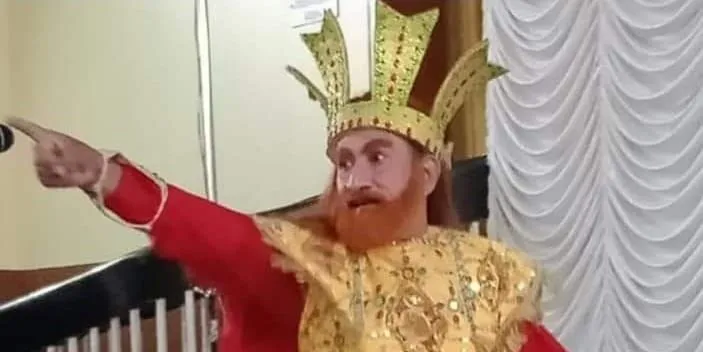
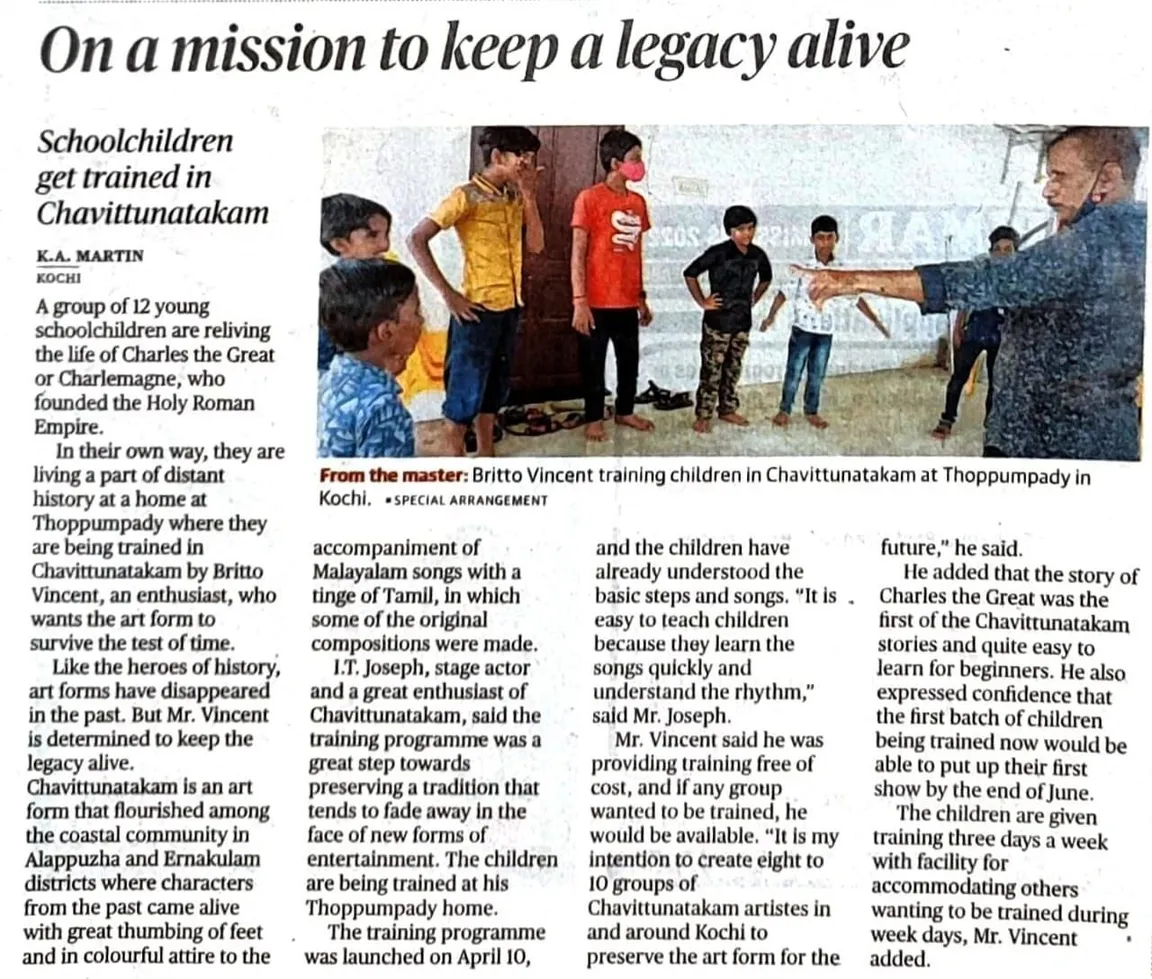
Some careers are carefully planned. Others emerge from unexpected turns. For Britto Vincent, one of Kerala’s most respected Chavittunadakam artists and writers, a chance visit to a rehearsal ground in Fort Kochi changed the course of his life. Britto is now known to us as a performer, playwright, teacher, organiser and cultural activist. He has received numerous honours for his contributions to Chavittunadakam.
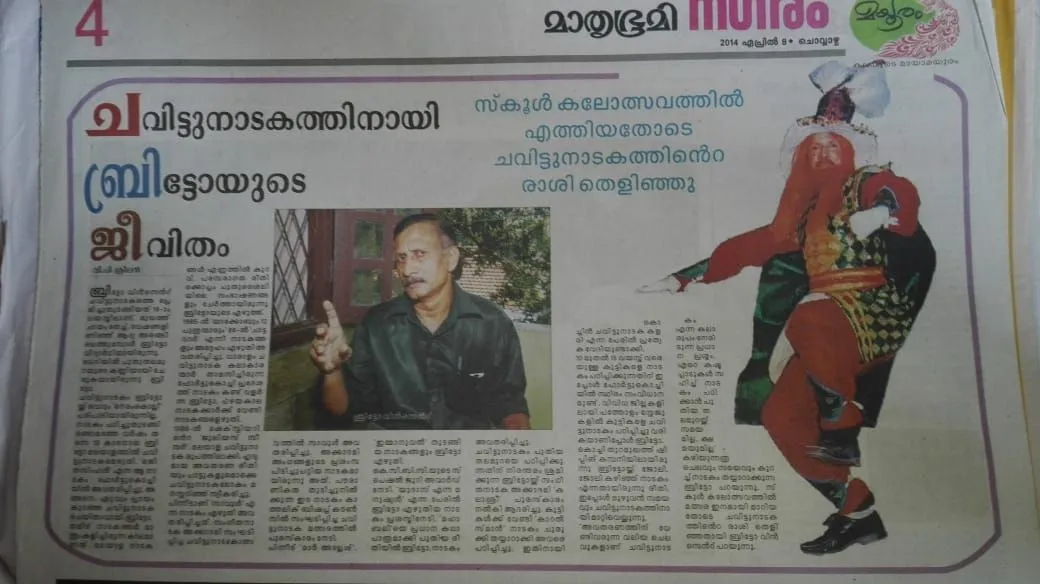
Born in 1964 in Fort Kochi, Britto grew up surrounded by Chavittunadakam. During his childhood, the art form flourished across the coastal belt. Within a small radius of his home, nearly twenty groups and dozens of theatre troupes regularly staged productions.
“Every Sunday there would be rehearsals somewhere,” he recalls. “You could hear the drums from different courtyards.”
Although his father was not a performer, many of his father’s friends were Chavittunadakam artists. This gave the young Britto rare access to backstage spaces, rehearsal camps and performance venues.
The world he encountered fascinated him. Chavittunadakam performers were treated with extraordinary respect in the community. Many played heroic characters such as Roland, St Sebastian and Charlemagne, figures larger than life both on and off the stage.
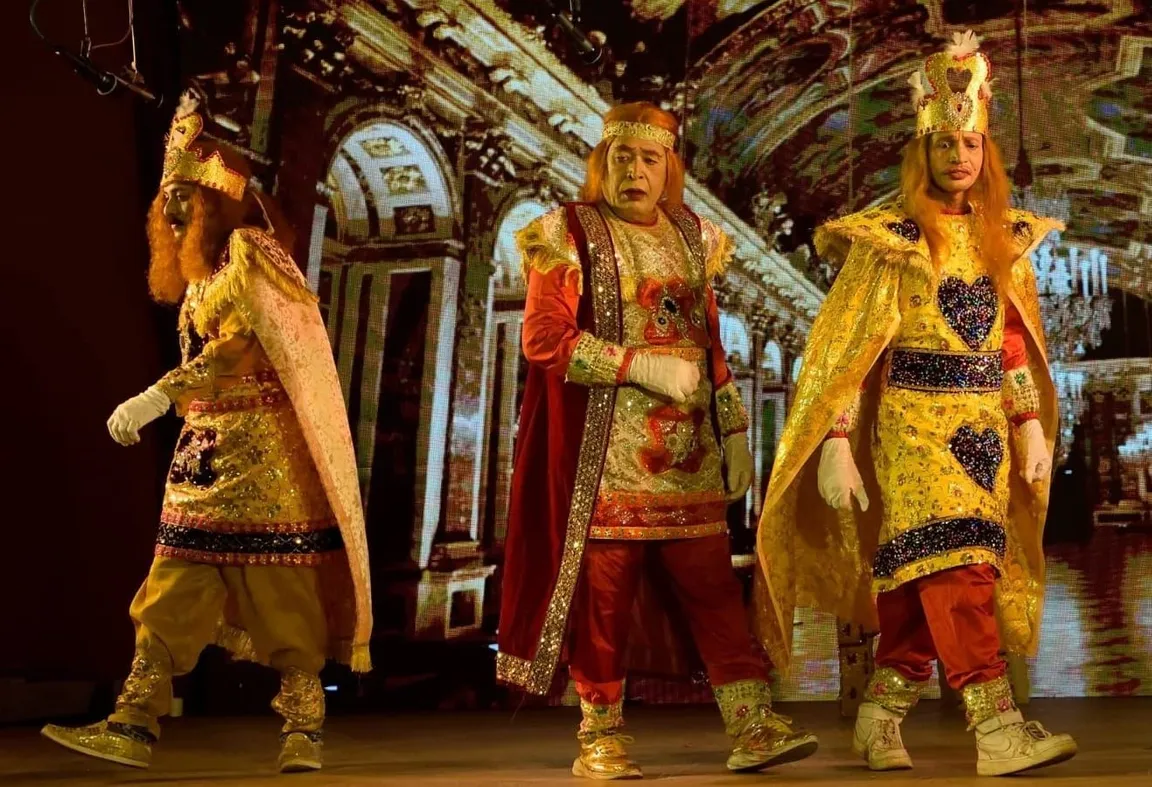
The actors were expected to sing, dance, act, and deliver dialogues. Physical strength was equally important. The vigorous stamping movements that define Chavittunadakam demanded stamina and discipline. Despite his admiration for the performers, Britto never imagined becoming one himself.
“We looked at them with such respect that it never occurred to us that we could do what they did,” he says.
Instead, he remained an enthusiastic spectator. He listened to the songs, watched rehearsals and absorbed the rhythms of the art form almost unconsciously. Even the lullabies of his childhood came from Chavittunadakam songs, sung by members of a family deeply involved in the tradition.
Growth to a Star
Everything changed in 1980. A children’s Chavittunadakam troupe was preparing for a performance. Just weeks before the show, the actor playing a key role withdrew after family objections. Organisers desperately searched for a replacement.
Around that time, Britto had been regularly attending rehearsals, standing quietly by a fence and watching. Someone noticed him and asked if he could help. Initially, he refused.
The organisers persisted. Eventually, he agreed to take on a small role. The training was difficult. The renowned teacher Josey Aashan was not convinced Britto could perform adequately. At one point, the young recruit was told he might have to step aside. Yet the troupe had no alternative. And so, the show went ahead.
What happened next surprised everyone. The audience responded enthusiastically to Britto’s performance. Even more remarkable was the reaction of the actor who had previously played the role in the adult’s performance. After watching from backstage, he reportedly told the teacher not to call him for that part again because he could not perform it as well as the newcomer had that night.
For Britto, the experience was transformative. “It gave me confidence,” he says, recalling that night.
Becoming a writer
The success encouraged him to stay close to his teacher and continue learning. Soon, another unexpected opportunity appeared. While still studying for his Pre-Degree course, Britto began writing a Chavittunadakam script.
At the time, scripts were traditionally written by senior scholars and experienced artists. The idea that an 18-year-old could write a full Chavittunadakam was difficult for many to accept. A Malayalam professor encouraged him to continue and helped refine the manuscript. Even then, few believed it would ever be staged.
Eventually, a young artist agreed to teach and perform the work. The production was successful and attracted attention for its emotional depth, particularly its portrayal of a mother-son relationship. The achievement established Britto as a promising new voice in the field.
His reputation grew steadily through the 1980s and 1990s. He continued acting while writing scripts that expanded the possibilities of Chavittunadakam.
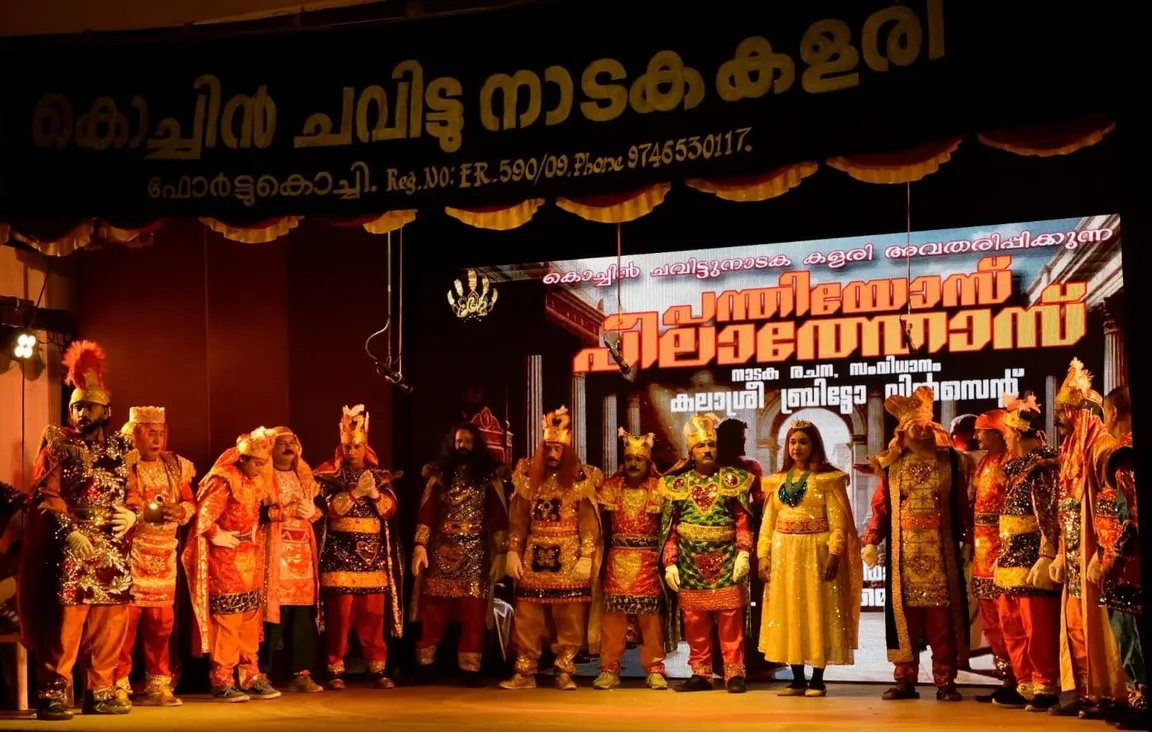
A breakthrough came in 1988 when he adapted Shakespeare’s “Julius Caesar” for the Chavittunadakam stage. Traditionally, the art form drew heavily from Biblical narratives, saints’ lives and legendary tales. Introducing Shakespeare was a bold experiment.
The production succeeded and brought Britto recognition throughout the Chavittunadakam community. More scripts followed, including St Paul, Saul, Judas and Pontius Pilate. His works became known for combining historical and religious themes with psychological depth and literary quality. Rather than simply retelling familiar stories, he explored the motivations and emotional struggles of his characters.
Recognition and Leadership
As Chavittunadakam entered a difficult period during the 1990s, Britto remained deeply involved. He worked with veteran masters, learning from some of the last great practitioners of an earlier generation. The revival of interest generated by the Kerala Sangeetha Nataka Akademi’s Chavittunadakam Festival in 1999 helped bring wider recognition to artists like him.
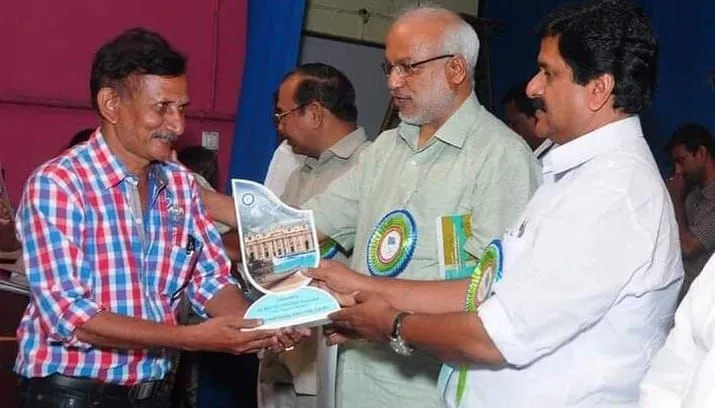
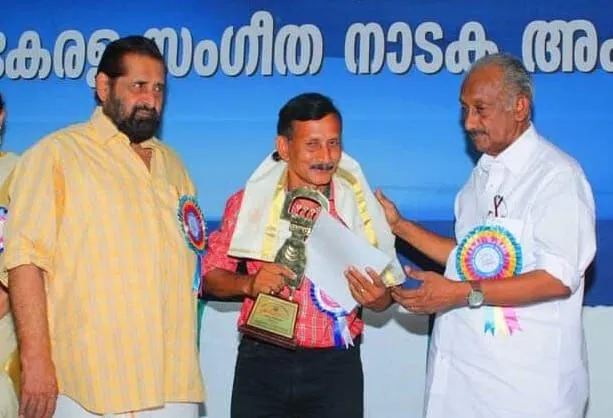
Over the years, Britto received numerous honours, including awards from the Kerala Folklore Academy, the Sangeetha Nataka Akademi and church-based cultural organisations. He trained students across most districts of Kerala and became a familiar name in cultural circles. His influence extended beyond performance to preservation, documentation and advocacy.
What began with a curious teenager standing beside a fence has become a lifelong mission. Through performance, writing and preservation, Britto has helped ensure that the powerful stamp of Chavittunadakam continues to resonate far beyond the coastal communities where it was born.
How can you help?
You can use the contact form below to reach out to the fellows directly. They would love to hear from you. A few words can go a long way. In fact, it's the only thing that holds us all together.

Proudly Not For Profit
Asking for donations is always difficult, especially if you are in India where asking for help is always seen as a sign of weakness. But, we believe that access to all the services aikyam provides should be forever free to amazing individuals like Britto. We are registered as a Not for Profit Company and do not charge any fee to anyone.
If you are somebody who feels that aikyam's work is important, please consider joining our Giving Circle and supporting our work with a monthly subscription. You can stop it anytime from your donation dashboard, no questions asked.
A large number of people like you giving small amounts of money over a long period of time is the way thousands of non profits like ours can continue working on difficult problems. In fact, it's the only way.
Thank you.


One more story like this one
You just read Britto Vincent’s story. Every fellow’s reaches your inbox the same way.
More fellows in Art & Culture
- Rahul Thomas
Theatre Saved Me
What happens when you walk away from a secure career to follow your calling?